
Bernoulli's theorem
As originally formulated, a statement of the conservation of energy (per unit mass) for an inviscid fluid in steady motion. The specific energy is composed of the kinetic energy (1/2)v2, where v is the speed of the fluid; the potential energy gz, where g is the acceleration of gravity and z the height above an arbitrary reference level; and the work done by the pressure forces ∫ αdp, where p is the pressure, α the specific volume, and the integration is always with respect to values of p and α on the same parcel. Thus, the relationship

is valid for steady motion, since the streamline is also the path. If the motion is also irrotational, the same constant holds for the entire fluid. The following special cases are important: 1) as originally formulated for a homogeneous incompressible fluid,

and 2) for a perfect gas undergoing adiabatic processes,

where cp is the specific heat at constant pressure and T the Kelvin temperature. If there is diabatic heating on the parcel at the rate dQ/dt per unit mass, then
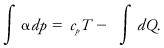
Gill, A. E. 1982. Atmosphere–Ocean Dynamics. Academic Press, . 82–83.