
steppe climate
(Also called semiarid climate.) The type of climate in which precipitation is very slight but sufficient for the growth of short, sparse grass. This is typical of the steppe regions of south-central Eurasia. In his 1936 climatic classification, W. Köppen assigns maximum values of annual precipitation to separate this dry climate from the rainy climates as follows. For precipitation chiefly in the winter,

For precipitation evenly distributed during the year,

For precipitation chiefly in the summer,

In the above, p is the mean annual precipitation in inches, and t the mean annual temperature in degrees Fahrenheit. (For minimum values of precipitation,
see formulas under desert climate.) This scheme was modified by Bailey to
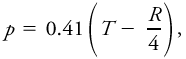
where R is the precipitation falling during the six colder months. In Köppen’s system the steppe climate is designated letter code BS. The semiarid climate of Thornthwaite (1931) corresponds closely to the steppe climate.
Köppen, W. P., and R. Geiger 1930–1939. Handbuch der Klimatologie. Berlin: Gebruder Borntraeger, 6 vols.
Thornthwaite, C. W. 1931. The climates of North America according to a new classification. Geogr. Rev.. 21. 633–655.