
Supercooled large drops
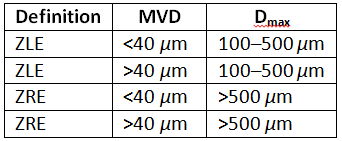
Liquid drops with diameters greater than 100 µm and internal temperatures less than 0°C, including freezing drizzle and freezing rain. When first introduced in 1994, the term supercooled large drops (SLD) was used mainly to denote environments aloft containing cloud drops, freezing drizzle drops, and/or freezing rain drops. It now also applies to freezing drizzle and freezing rain at the surface. Table 1: The identification of four subsets of SLD conditions aloft, summarized below, where ZLE stands for freezing drizzle environment, ZRE stands for freezing rain environment, MVD represents the median volume diameter (half of the water volume is contained in drops of smaller diameter, half in drops of larger diameter), and Dmax represents the maximum diameter of the drops in the environment (Appendix O from DOT/FAR/AR-09/10).
Air Traffic Organization Operations Planning, Office of Aviation Research and Development, 2009: Data and analysis for the development of an engineering standard for supercooled large drop conditions. FAA Rep. DOT/FAA/AR-09/10, 89 pp. [Available online at http://www.tc.faa.gov/its/worldpac/techrpt/ar0910.pdf.]
FAA, 2016: Supercooled large drop icing conditions. Airworthiness Standards: Transport Category Airplanes, Appendix O to Part 25, Aeronautics and Space, Title 14, Code of Federal Regulations, National Archives. [Available from the U.S. Gov. Publishing Office, 710 N. Capitol St. N.W., Washington, DC 20403.]
Term edited 25 July 2016.