
universal functions
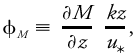
According to the Monin–Obukhov similarity theory, the dimensionless shear
temperature gradient
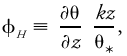
and other gradients in the surface layer are proportional to dimensionless universal stability functions, where M is wind speed, θ is potential temperature, u* is friction velocity, and θ* is the surface kinematic heat flux divided by friction velocity.
These functions have a value of nearly 1 for neutral stratification, range over 0 < (z/L) < 1 for unstable stratification, and z/L > 1 for stable stratification, where z is height above the surface and L is the Obukhov length. For strong stability (z/L » 1) the universal functions are nearly constant. Presently the most-used universal functions are based on an experiment conducted in Kansas in 1968, with some corrections made in the succeeding 30 years. The accuracy is about 10% for unstable and 20% for stable stratification. The following empirical forms of the universal functions, based on a von Kármán constant of k = 0.4, are currently used. For unstable stratification:

For neutral stratification:

For stable stratification:

These universal functions are
also called flux-profile relationships.