
eddy flux
(Or turbulent flux.) The rate of transfer of a conservative fluid property through a surface by turbulent eddies. In the case of an unchanging mean state, the eddy flux of a property S in the z direction is expressed by

where lower case represents turbulence values (fluctuations from the mean), w represents vertical velocity, ρ density, and the bar represents the mean over a chosen period. By analogy with molecular diffusion, the eddy flux in the planetary boundary layer is often expressed by

where Ks is the turbulent transfer coefficient (also turbulent exchange coefficient, or eddy diffusivity). This can be generalized to include eddy diffusion in the horizontal (x, y) plane. If S is replaced by cpT, where cp represents specific heat at constant pressure and T represents temperature, the vertical turbulent heat flux (or eddy heat flux) can be represented by
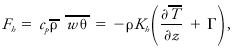
where θ is the temperature fluctuation, Kh the eddy thermal diffusion coefficient (or eddy conductivity), and Γ represents the adiabatic lapse rate. Similarly, eddy momentum flux is represented by
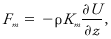
where U represents the mean speed in the direction of the mean wind, and Km represents the eddy viscosity coefficient (or eddy viscosity). Also, the turbulent transfer of water vapor may be expressed in energy units by
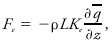
where L represents the latent heat of vaporization, Ke is the eddy diffusion coefficient, and  is the specific humidity.
See also diffusion, turbulence.
Fleagle, R. G., and J. A. Businger 1980. An Introduction to Atmospheric Physics. 2d ed., Academic Press, . 266– 272.